

Four-Day Declines and what History SaysSince the Reciprocal Tariffs announcement by Trump on 2/4/25, this was how the S&P 500 ended:
2/4/25 – 5670
3/4/25 – 5396
4/4/25 – 5074
7/4/25 – 5062
8/4/25 – 4983
a loss of 12.1% in the 4 days following the announcement and a drop of 19% from its peak of 6147 in Feb 2025.
Based on data collected by Creative Planning Chief Market Strategist Charlie Bilello, the S&P 500 has endured 15 Four-day Declines of 11.5% to 28.5% between 1950 and 2025. This period saw dramatic falls during the Black Monday crash of 1987, the Global Market Collapse of 2008, and the 2020 COVID pandemic crash. In these scenarios, the analyst worked out that the total returns (including dividends) of the S&P 500 at the one, three and five-year periods following each of these four-day declines were always higher than the total decline at the time.
Source: Yahoo Finance
Ken Fisher weighs in on Recession OutlookBillionaire investor Ken Fisher (who is the son of Phil Fisher*) weighed in on the possibility of a recession this year with his dismal outlook if tariffs aren’t rolled back following the 90-day pause in reciprocal tariffs.
“If it does not resolve that President Trump and crew have negotiated some deals and then put all of this nonsense behind us, or 90% of all this nonsense behind us, you’ll see a very bad economic effect that will cause a recession, and it will be recession before the end of the year.”
While it’s too early to declare a recession, Fisher was quoted as saying:
“We never get a recession unless the US stock market and global stock market have peaked from an all-time high and gone down for three or fourth months,” said Fisher. “It won’t start any sooner than that.”
Source: The Street
* Phil Fisher, the author of “Common Stocks and Uncommon Profits” is credited as the father of value investing and widely revered by investment legends such as Warren Buffett.
Escalating Trade Tension to lift China’s demand for Palm OilThe escalating trade tension between US and China will likely further reduce China’s soybean imports dependency on the US by diverting part of its soybean imports to South America. This will benefit Brazil and Argentina, the world’s largest and third largest soybean producing countries. It may also result in replacement of China’s soybean demand to palm oil as a substitute.
What happened during the first US-China tariff tension in 2018?
Recall, China’s move to impose a 25% tariff on US soybean imports in retaliation against US tariffs) had resulted in China’s soybean imports from US declining by 57% (or 18.6m metric tons) in 2018. During the same time, its soybean imports from Brazil rose by 41% (or 21.8m metric tons) and resulted in China’s palm oil imports increasing by 5% to 5.3m metric tons.
Tariffs have muted impact on US palm oil demand
The impact of US tariff on America’s palm oil demand, on the other hand, will likely be muted. In 2024, US imported a total of 1.8m metric tons of palm oil, mostly from Indonesia.
Source: HLIB Research 17/4/25
Canada and Japan big buyers of Treasuries in FebruaryAgainst the backdrop of the current US Treasury sell off, it is interesting to note that Canada and Japan were among the biggest net buyers during the preceding month. Foreign holdings of Treasury securities hit a high of US$8.82 trillion in February. Here’s a tally of the large foreign holders:
Japan $1.13 trillion
China $784.3 billion
UK $750.3 billion
Belgium US$394.7 (include Chinese custodial accounts)
The foreign holdings for April will only be revealed in June, giving more clarity over any weaponization issue and strategy via US Treasuries.
The US Treasuries SelloffThere are trade war theories that China is weaponizing their US Treasury holdings although some analysts disagree as the sell down may necessitate capital being moved back into China causing yuan appreciation. Others say that China can also convert the proceeds into Euros or German bunds. May explain Germany’s bunds bucking a wider sell-off in long-dated Treasuries last week. Other theories point to Japan’s life insurers selling due to concerns about US policy flip-flops, while others say it is the Hedge Funds and Bond Vigilantes.
Source: CNBC
Rare Event could send S&P 500 tumbling againWhen the 50-Day Moving Average crosses below the 200-Day Moving Average, some chartists see this signal as a turning point known as a “death cross.” The S&P 500 suffered its first death cross since 2022 this week whereby investors can potentially suffer substantial short-term losses.
Source: TheStreet
Banking Shares expected to stay Rangebound pending trade clarityNotwithstanding the current trade war climate, CIMB Research does not believe that the price-to-book valuations of banking stocks will fall to the COVID-19 lows of 0.3 to 0.5x Book Value. During the pandemic lockdown, 70% to 80% of loans were placed under moratorium in the initial phase, before dropping to 30% on an opt-in basis towards the end of 2020. However in the current scenario, loan relief assistance can be more targeted towards exporters and affected companies in the supply chain, making the current uncertainty less widespread as compared to the pandemic days.
Source: TheStar
When does History say Stocks might Recover after a Market Crash?2020 COVID-19 Market Crash
S&P 500 dropped almost 14% over two days on 11 and 12 March, bottoming out on 23 March, with declining another 10% making a total decline from peak of around 34%. This was a steep yet quick fall with a fast recovery due to Fed intervention.
2008 Subprime Mortgage Crisis
S&P500 declined by 8.8% on 29 Sep and later declined by about 20% the week of Oct. 6. The market found a bottom five months later in early March 2009 losing another 44% after the initial plunge on 29 Sep. The S&P500 lost more than half its value during the five month bear market and took more than five years for the market to return to new highs. The Fed slashed interest rates to near zero percent and initiated QE.
1987 Black Monday
The DJIA lost 22.6% on 19 Oct as a result of to overvaluation and speculation. It reached a second bottom in early December and took nearly two years to reach new highs. The crash was a valuation reset after a long bull market.
1929 Wall Street Crash
The Dow Jone plunged 23% over a two-day period in late October resulting from runaway speculation and high valuations. Several tough followed as the DJIA would decline another 82% before reaching a bottom in July 1932. The Dow’s peak to trough decline was 89% and it took 25 years for the market to fully recover.
Source: Motley Fool
US Treasury sees modest pickup in customs duties amid widening deficitThe US Treasury received US$9.0 billion of customs revenue for March, a US$2.0 billion increase from 2024. The federal deficit hit US$1.31 trillion in six months, up 15% from a year earlier.
Source: AHIB
Credit Markets ParalysedCompany debt sales have ground to a halt in the US following Trump’s escalating trade war and fears of a global recession. Several leveraged loan sale and debt refinancing have been put on hold and no new US investment-grade bonds have been issued since Wednesday 2/4/25. Transactions on riskier debt are being pulled or postponed, while perceived risk for high-grade and high-yield US corporate bonds are flashing warning signs.
Source: The Star
The DJIA index fell 22.6% on Monday 19 October 1987, plunging 508 points to 1738. In the wake of Trump’s tariff war announced on 2/4/25, a similar percentage fall on Monday 7/4/25 would have taken 8,000 points off the DJIA. As it turned out, Monday was relatively calm following Thursday’s 5% drop and Friday’s 6% drop.
Source: 247 Wallst
US imports a lot more goods from China (US$439.7 billion) than it exports (US$144.6 billion).
Soybeans, oilseeds and certain grains were a key US export to China, amounting to US$13.4 billion last year. And China bought 52% of US soybean) exports in 2024.
Source: Malay Mail
Nike stock price rallied 4% after Trump’s post that he had a call with Vietnam’s To Lam. About 25% of Nike’s footwear is made in Vietnam. Nike is also one of the biggest holdings of Ackman’s portfolio. On 28/6/24, it reported sales that missed analyst estimates. The stock fell 20%, its biggest one-day drop since 1980. Nike’s stock price had tumbled 30% in 2024.
Source: The Street
Trade war will result in China moving towards alternative agriculture suppliers including Brazil. China is imposing additional duties of 34% on all US goods (on top of the 10%-15% tariffs) placed on US$21 billion worth of agricultural products, effectively closing doors on all US agricultural imports. The main impact will be on products like soybeans and sorghum, not so much on wheat and corn as China has not been buying much of wheat and corn from the US in 2025. EU is likely to put tariffs on US soybeans, leading to product substitution to others such as palm oil.
Source: The Edge
“Liberation Day” Tariffs Explained
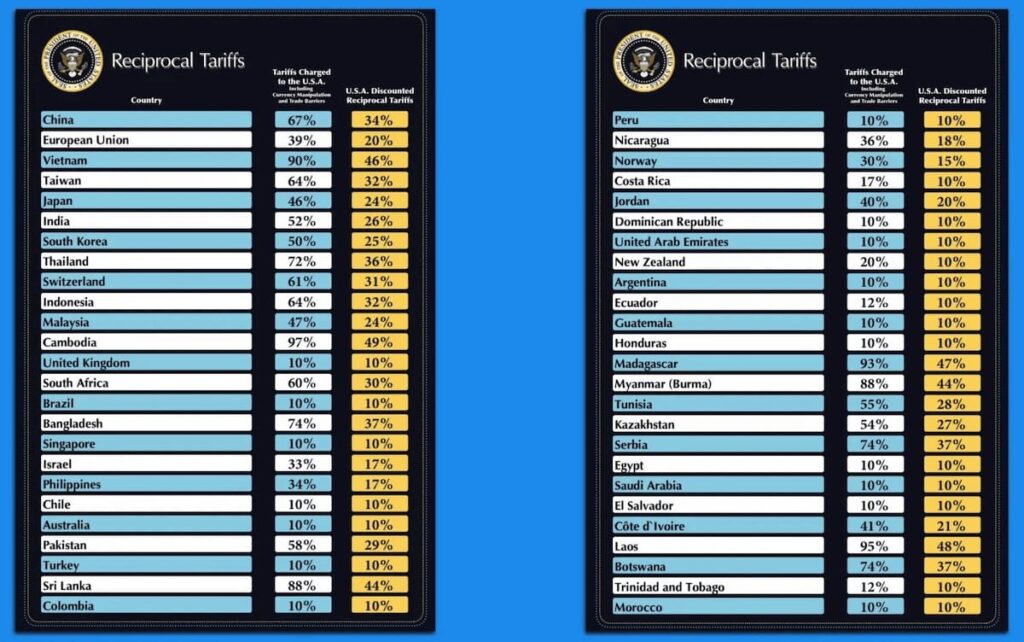
1. Trump’s (特离谱) All-Out Tariff Strategy
Trump’s “global tariff” plan is not primarily aimed at fixing trade deficits or reshoring manufacturing. It is a geopolitical and financial maneuver to force all countries to bear the cost of U.S. debt—a move to “leverage U.S. market access to coerce foreign cooperation.”
2. The Real Crisis: U.S. Sovereign Debt
As of early 2025: Debt: $36 trillion+
Annual tax revenue: $5 trillion
Annual spending: $6.75 trillion
Debt interest: $1.12 trillion
This creates a dangerous debt spiral: deficit → borrow more → pay more interest → deeper deficit.
3. August 2025 Deadline: The Ticking Bomb
Debt ceiling set at $36.1 trillion.
U.S. Treasury using emergency measures to avoid breaching the cap.
Come August–September 2025, funds will be exhausted unless the cap is raised.
Source: Unknown
More Reading: Raise Money Now, Cut Taxes Later
4. Need for $6 Trillion in 2025
To stay afloat in 2025, the U.S. needs to raise:
$3 trillion (for maturing bonds)
$1.12 trillion (for interest)
$2 trillion (budget deficit)
=> Need total of $6 trillion in new debt
The market may not be able to absorb such volume, threatening the collapse of the U.S. Treasury market and dollar credibility.
5. Trump’s Initial Moves
Budget cuts: $2 trillion
Cut foreign aid (e.g., Ukraine), sell immigration “green cards”
Created “Department of Government Efficiency” led by Elon Musk (which failed)
These actions hint at an impending fiscal cliff, and tariffs are just phase one of a larger plan.
6. Conclusion
Tariffs won’t raise $6T before August 2025.
Trump is forcing countries to indirectly pay by buying U.S. debt.
Expect further escalation if countries resist.
The goal: Avoid default, preserve dollar hegemony, and control inflation without expanding the Fed’s balance sheet.
A steep correction could be in store for gold price according to Morningstar’s Jon Mills. There are long-term trends that could push bullion back to $1,820. Current high price and margins are encouraging greater production and exploration. Global central banks purchased a net 1,045 tons of gold through 2024, the third straight year of purchases over 1,000 tons. Inflows into Gold ETFs reached $9.4 billion in February, the highest inflow in nearly three years (World Gold Council data). But there are signs that the world’s appetite for gold is starting to wane. In a survey by WGC last year, 71% of central banks said they expected their own gold holdings to remain the same or decrease in the coming 12 months. Also investor appetite will likely dip, given that economic concerns are typically only short-term factors influencing gold prices: Eg Gold price briefly spiked in 2020 in response to pandemic fueled concerns. But price fell quickly thereafter and didn’t reach the prior peak until late 2023.
Source: Yahoo Finance
Foreign investors extended their selling streak on Bursa Malaysia for the 22nd consecutive week, with a net outflow of RM1.25 billion. Foreign ownership in Malaysia Treasury Bills in Feb 2025 stood at 52.7%, while Bank Negara Malaysia’s international reserves stood at US$118 billion.
Source: The Edge
According to BoA, S&P500 could see 12% drop to 5000 in a downturn with increased unemployment, then increase to 5500 to end 2025. At the time of publication (EOD 27/3/25), S&P500 closed at 5712 and tumbled to 5074 at EOD 4/4/25 in response to Trumps’ Liberation Day tariff announcement on 2/4/25.
Source: Business Insider
Alliance Bank Rights Issue to raise up to RM600 million
Alliance Bank is seeking to raise as much as RM600 million in fresh capital via a rights issue of new shares to fund its general banking, financing and investing activities. Alliance Bank’s share price closed at RM5.09 on 21/3/25, gaining around 50% over the past 12 months and giving it a market capitalisation of RM7.87 billion. The rights issue is expected to be completed by the third quarter of 2025 and is subject to regulatory and shareholder approvals.
Source: TheEdge